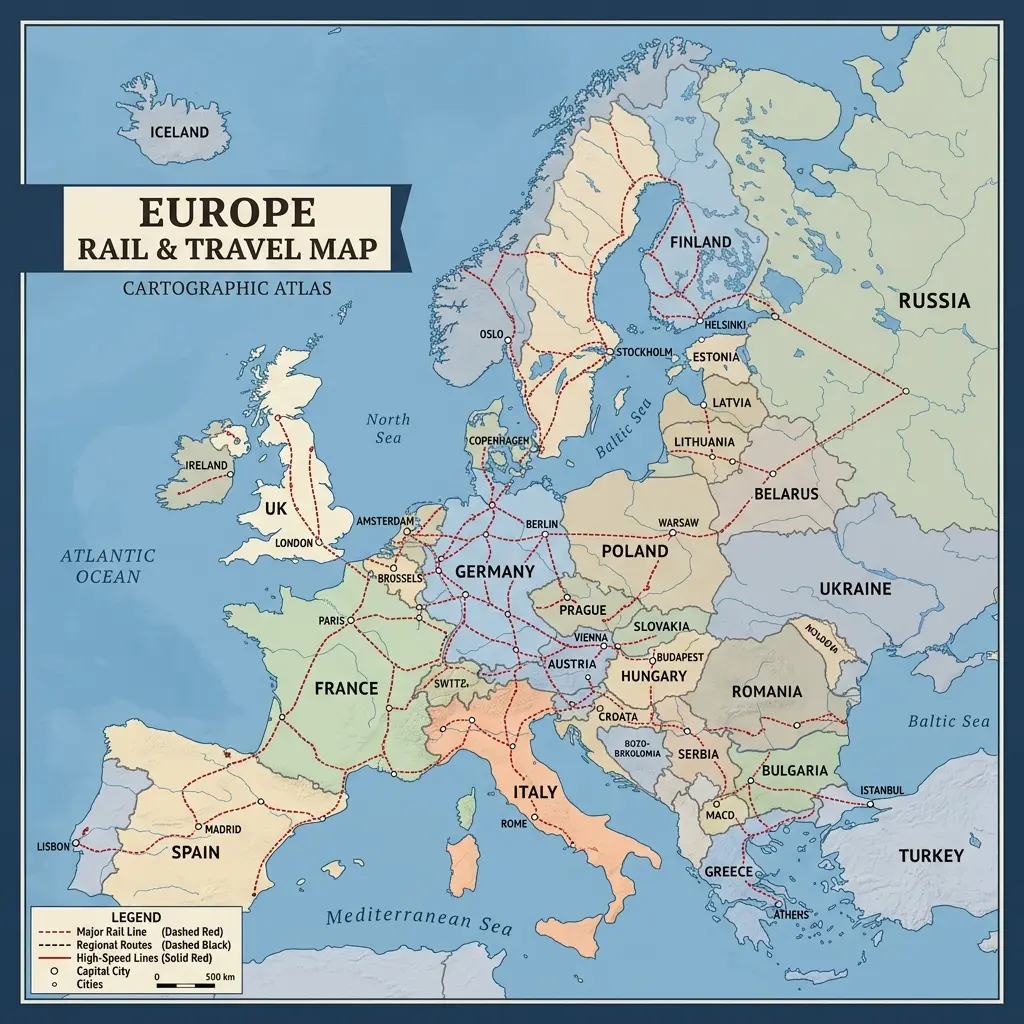
Planning a multi-country trip across Europe by train? This Europe rail travel map shows the continent's major rail corridors connecting key cities from Lisbon to Helsinki. Europe has the world's densest high-speed rail network, and this map marks the routes that make it possible to cross from London to Istanbul, Madrid to Warsaw, or Stockholm to Rome — all by train. Click any country on the map above to see its capital and key travel data.
Major European Rail Routes
Europe's rail network covers over 220,000 kilometers of track across 33 countries accessible with a Eurail pass. The highest-traffic international corridors include:
- London → Paris → Brussels → Amsterdam — Eurostar and Thalys high-speed services, connecting four capitals in under 6 hours total
- Paris → Lyon → Marseille → Barcelona — TGV France into AVE Spain, covering 1,000+ km of Mediterranean coast
- Berlin → Prague → Vienna → Budapest — the Central European corridor through four historic capitals
- Zurich → Milan → Rome → Naples — traversing the Alps via the Gotthard Base Tunnel (57 km, the world's longest railway tunnel)
- Stockholm → Copenhagen → Hamburg → Berlin — the Scandinavian-to-Central-Europe link via the Øresund Bridge
High Speed Rail Networks in Europe
Five countries operate dedicated high-speed rail networks reaching 250 km/h or above: France (TGV, up to 320 km/h), Spain (AVE, 310 km/h), Germany (ICE, 300 km/h), Italy (Frecciarossa, 300 km/h), and the UK/France/Belgium corridor (Eurostar, 300 km/h). Together these networks cover approximately 11,000 km of dedicated high-speed track, with expansion ongoing — France is extending TGV service to Bordeaux and Toulouse, Spain is building AVE connections to Galicia and Extremadura, and Germany is upgrading the Berlin-Munich ICE corridor.
Budget Rail Travel Across Europe
Rail travel does not have to be expensive. Most Western European countries offer advance-purchase fares at significant discounts: Deutsche Bahn's Super Sparpreis tickets start at €17.90 for any domestic route in Germany, French TGV Ouigo services sell from €10, and Italian Trenitalia offers Cartafreccia discounts of 20-50 percent. The Eurail Global Pass offers a flat-rate option for multi-country travel, starting at around €200 for 4 travel days within one month. For budget-conscious travelers, combining advance-purchase high-speed tickets with slower regional trains on connecting legs is typically the most cost-effective approach.
Frequently Asked Questions
What is the best rail pass for traveling across Europe?
The Eurail Global Pass is the most comprehensive option, covering train travel in 33 European countries. It is available in various durations from 4 days within a month to 3 months continuous. For travel within a single country, national rail passes (like the BritRail Pass for the UK or Swiss Travel Pass for Switzerland) often offer better value. The Interrail Pass is the equivalent for European residents.
Can you take a train from London to Paris?
Yes, the Eurostar high-speed train connects London St Pancras to Paris Gare du Nord in approximately 2 hours and 16 minutes via the Channel Tunnel. Trains run multiple times daily. You can also connect from London to Brussels (2 hours) and Amsterdam (3 hours 52 minutes) via Eurostar.
What are the fastest trains in Europe?
Europe has several high-speed rail networks. The French TGV reaches speeds of 320 km/h on the Paris-Lyon-Marseille corridor. The Spanish AVE operates at 310 km/h connecting Madrid to Barcelona, Seville, and Valencia. Germany's ICE runs at up to 300 km/h, and Italy's Frecciarossa reaches 300 km/h between Rome and Milan. The Eurostar through the Channel Tunnel operates at 300 km/h.
Which European countries have the best train networks?
Switzerland is widely regarded as having the best rail network in Europe in terms of punctuality, coverage, and scenic quality. Germany has the largest rail network by track length. France excels in high-speed connections between major cities. The Netherlands has the densest rail network relative to its size. Japan-style punctuality is most closely matched by the Swiss Federal Railways (SBB).
How far in advance should I book European train tickets?
For the best prices on high-speed and international routes, book 2 to 3 months in advance. Most European rail operators release tickets 90 days before departure. Last-minute tickets can cost 3 to 5 times more than advance fares. However, regional and local trains in countries like Germany, Switzerland, and Austria often have fixed prices regardless of when you book.
This Europe rail travel map draws route data from publicly available timetable information. For general Europe geography, return to the interactive Europe map. To test your knowledge of European countries, take the Europe map quiz. For a physical copy, download a printable Europe map.
Static Illustration of the Europe Rail Map
For trip planning and transit routing, here is a static map of the main European rail and travel corridors: