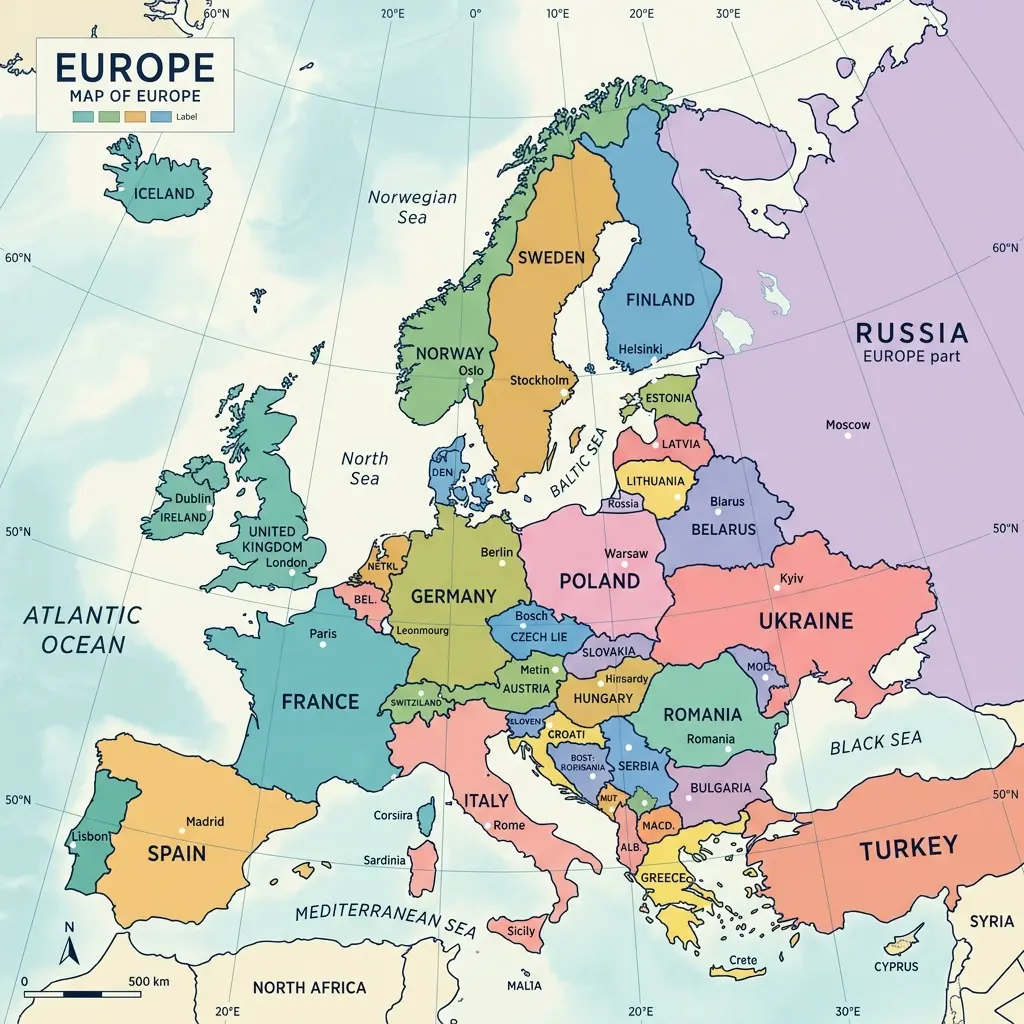
Europe is home to some of the world's most iconic cities, and this Europe map with major cities pins every capital and major population center across the continent. From London and Paris in the west to Moscow and Istanbul in the east, the map above shows the urban centers that drive European culture, commerce, and history. Click any country to see its capital and key statistics, or scan the city dots to identify major population hubs across all 44 European nations.
The Most Populated Cities in Europe
Europe's city landscape reflects centuries of evolving political and economic power. Istanbul straddles two continents and leads by metropolitan population at over 15 million. Moscow's 12.5 million makes it the largest city entirely within Europe by city-proper count. London, Berlin, Madrid, Rome, Paris, and Kyiv round out the top tier, each home to millions. But population alone does not capture a city's significance — Vienna has 1.9 million people but serves as the headquarters for OPEC, the OSCE, and several UN agencies.
European Cities as Transportation Hubs
Major European cities function as critical nodes in the continent's dense transportation network. London's six airports handle over 180 million passengers annually. Paris's Charles de Gaulle and Frankfurt International serve as primary connection points for intercontinental travel. High-speed rail networks link major cities across Western Europe: the Eurostar connects London to Paris in 2 hours 16 minutes, the TGV covers Paris to Lyon in under 2 hours, and Germany's ICE network connects Berlin, Frankfurt, Munich, and Hamburg. For rail travel planning across the continent, see the Europe rail and travel map.
Historic and Cultural Capital Cities of Europe
Many European capitals serve as living museums of their nation's history. Athens traces its habitation back over 3,400 years. Rome was the center of an empire that controlled the entire Mediterranean basin. Paris, London, Vienna, and Prague each preserve centuries of architecture spanning from medieval fortifications to modern landmarks. Even smaller capitals carry outsized historical weight — Valletta, Malta (population 6,000) is one of the most concentrated historic areas in the world, with a UNESCO World Heritage designation covering the entire city.
Frequently Asked Questions
What are the largest cities in Europe by population?
The largest cities in Europe by population include Istanbul (15.5 million, metro), Moscow (12.5 million), London (9 million), Saint Petersburg (5.4 million), Berlin (3.6 million), Madrid (3.2 million), Kyiv (2.9 million), Rome (2.8 million), Paris (2.2 million city proper), and Bucharest (1.8 million). Rankings vary depending on whether city proper or metropolitan area figures are used.
What is the most visited city in Europe?
London, Paris, and Istanbul consistently rank as the most visited European cities. London and Paris each attract over 19 million international visitors annually, while Istanbul receives approximately 15 million. Other top destinations include Barcelona, Amsterdam, Rome, Prague, and Vienna, each drawing between 6 and 10 million international visitors per year.
Which European city has the oldest continuously inhabited history?
Athens, Greece is widely considered the oldest continuously inhabited city in Europe, with a recorded history spanning over 3,400 years. Other contenders include Plovdiv in Bulgaria (over 6,000 years of habitation) and Argos in Greece. In Western Europe, Cadiz in Spain (founded c. 1100 BCE) and Lisbon in Portugal are among the oldest.
How many capital cities does Europe have?
Europe has 44 capital cities, one for each sovereign state. Some countries have multiple cities that serve capital functions: the Netherlands has Amsterdam as constitutional capital and The Hague as seat of government; Malaysia's Putrajaya serves as administrative capital alongside Kuala Lumpur. In Europe, only the Netherlands has this dual-capital arrangement among recognized sovereign states.
What European city has the highest cost of living?
Zurich, Switzerland consistently ranks as the most expensive city in Europe, followed by Geneva, Basel, London, Copenhagen, and Oslo. The Nordic capitals (Oslo, Stockholm, Helsinki, Copenhagen) and Swiss cities dominate the top spots. In contrast, cities in Eastern Europe like Sofia, Bucharest, Belgrade, and Kyiv offer significantly lower costs of living.
This Europe map with major cities uses Natural Earth data with capital city coordinates. For the full country-by-country breakdown with population and area data, see the Europe map with countries and capitals. To explore how cities cluster by region, visit Europe map by region.
Static Illustration of the Europe Major Cities Map
For reference or trip planning, here is a high-quality static map of Europe showing major urban centers: