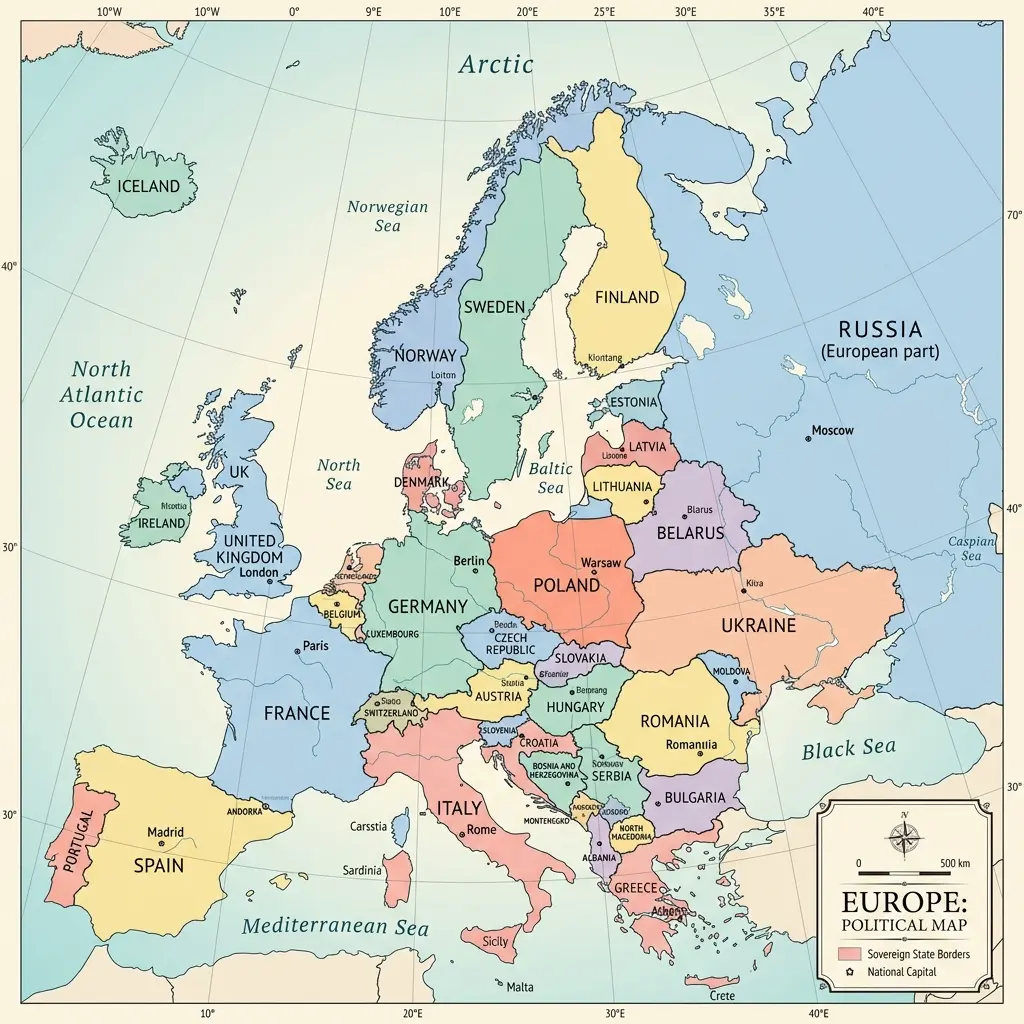
The European Union is a political and economic partnership of 27 countries, and this EU countries map highlights every member state on an interactive map of Europe. The 27 nations highlighted above share a single market, coordinate foreign policy, and collectively represent over 447 million people — making the EU the third-largest population bloc in the world after China and India. Click any highlighted country to see its capital, population, currency, and the year it joined the union.
All 27 European Union Countries Listed
The table below lists every current EU member state with its capital city, population, and the year it joined the European Union. Click any column header to sort. The six founding members (Belgium, France, Germany, Italy, Luxembourg, Netherlands) created the European Economic Community in 1957. The largest expansion happened in 2004 when ten countries joined simultaneously, mostly from Central and Eastern Europe. For full information on the EU and its institutions, visit the official European Union website.
| Country | Capital | Population | Joined EU |
|---|---|---|---|
 Austria Austria | Vienna | 9,006,398 | 1995 |
 Belgium Belgium | Brussels | 11,589,623 | 1957 |
 Bulgaria Bulgaria | Sofia | 6,927,288 | 2007 |
 Croatia Croatia | Zagreb | 4,105,267 | 2013 |
 Cyprus Cyprus | Nicosia | 1,207,359 | 2004 |
 Czech Republic Czech Republic | Prague | 10,708,981 | 2004 |
 Denmark Denmark | Copenhagen | 5,818,553 | 1973 |
 Estonia Estonia | Tallinn | 1,326,535 | 2004 |
 Finland Finland | Helsinki | 5,540,720 | 1995 |
 France France | Paris | 67,390,000 | 1957 |
 Germany Germany | Berlin | 83,783,942 | 1957 |
 Greece Greece | Athens | 10,423,054 | 1981 |
 Hungary Hungary | Budapest | 9,660,351 | 2004 |
 Ireland Ireland | Dublin | 4,937,786 | 1973 |
 Italy Italy | Rome | 60,461,826 | 1957 |
 Latvia Latvia | Riga | 1,886,198 | 2004 |
 Lithuania Lithuania | Vilnius | 2,722,289 | 2004 |
 Luxembourg Luxembourg | Luxembourg City | 625,978 | 1957 |
 Malta Malta | Valletta | 441,543 | 2004 |
 Netherlands Netherlands | Amsterdam | 17,134,872 | 1957 |
 Poland Poland | Warsaw | 37,846,611 | 2004 |
 Portugal Portugal | Lisbon | 10,196,709 | 1986 |
 Romania Romania | Bucharest | 19,237,691 | 2007 |
 Slovakia Slovakia | Bratislava | 5,459,642 | 2004 |
 Slovenia Slovenia | Ljubljana | 2,078,938 | 2004 |
 Spain Spain | Madrid | 46,754,778 | 1986 |
 Sweden Sweden | Stockholm | 10,099,265 | 1995 |
EU Membership vs Geographic Europe
A common source of confusion is the difference between the EU and Europe itself. Europe as a continent has 44 countries; the EU has 27 members. Several major European nations are not EU members: the United Kingdom left in 2020, Norway and Switzerland have never joined (though both participate in aspects of the single market), and Ukraine became an official candidate country in 2022. Turkey has been a candidate since 1999 but accession talks have made limited progress.
The Eurozone and the Single Currency
Of the 27 EU members, 20 use the Euro (€) as their official currency, forming the Eurozone. The remaining seven — Poland, Czech Republic, Hungary, Sweden, Denmark, Romania, and Bulgaria — maintain their own national currencies. Denmark has a formal opt-out from the Euro, while the others are technically committed to adopting it once they meet the convergence criteria. This distinction matters for travelers: crossing from Germany (Euro) into Poland (Złoty) or from France (Euro) into Switzerland (Swiss Franc) means a currency change even though the border is open under Schengen.
Frequently Asked Questions
How many countries are in the European Union?
The European Union currently has 27 member states. The most recent country to join was Croatia in 2013. The UK left the EU on January 31, 2020 (Brexit), reducing the count from 28 to 27. Several countries are currently candidates for membership, including Ukraine, Moldova, Turkey, and several Western Balkan nations.
What is the difference between Europe and the EU?
Europe is a geographic continent with 44 countries. The European Union (EU) is a political and economic union of 27 of those countries. Being in Europe does not automatically mean being in the EU. Countries like Norway, Switzerland, the United Kingdom, and Iceland are European but not EU members.
Which countries are candidates to join the EU?
Current EU candidate countries include Ukraine, Moldova, Bosnia and Herzegovina, North Macedonia, Montenegro, Serbia, Albania, Turkey, and Georgia. Each country must meet the Copenhagen criteria — standards of democratic governance, human rights, rule of law, and a functioning market economy — before accession negotiations can conclude.
What are the founding members of the European Union?
The EU traces its origins to the European Economic Community (EEC), founded in 1957 by six countries: Belgium, France, Germany, Italy, Luxembourg, and the Netherlands. These six signed the Treaty of Rome, which established the common market that evolved into today's European Union through subsequent treaties including Maastricht (1992) and Lisbon (2007).
Do all EU countries use the Euro?
No. While the Euro is the official currency of the Eurozone, not all EU members have adopted it. As of 2026, 20 of the 27 EU member states use the Euro. Countries like Poland (Złoty), Czech Republic (Koruna), Hungary (Forint), Sweden (Krona), Denmark (Krone), Romania (Leu), and Bulgaria (Lev) maintain their own currencies, though several are committed to adopting the Euro in the future.
This EU countries map is sourced from official European Union data via europa.eu and Eurostat. For the full list of all 44 European countries including non-EU nations, see Europe map with countries and capitals. Explore each country on the interactive Europe map.
Static Illustration of the EU Countries Map
For reference or sharing, here is a high-resolution static map highlighting the 27 European Union member states: