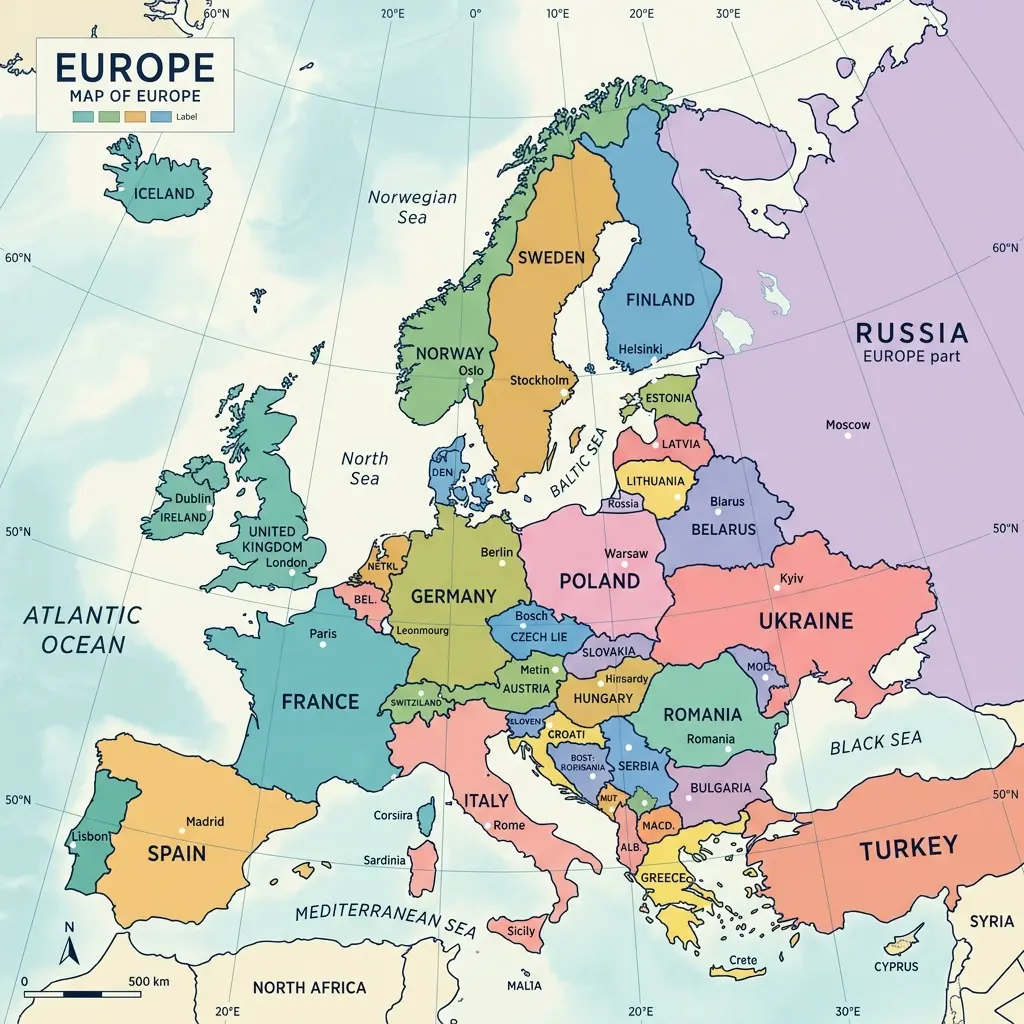
There are 44 countries in Europe, and this Europe map with countries and capitals lists every one of them in a sortable, searchable table alongside an interactive map. From Moscow to Reykjavik, from Lisbon to Nicosia, every capital city is pinned on the map above — click any country to see its full data profile. The table below lets you sort by population, area, or region to quickly find what you are looking for.
Complete Table of European Countries and Capitals
| Country | Capital | Population | Area (km²) | Region |
|---|---|---|---|---|
 Albania Albania | Tirana | 2,877,797 | 28,748 | Southern |
 Andorra Andorra | Andorra la Vella | 77,265 | 468 | Southern |
 Austria Austria | Vienna | 9,006,398 | 83,879 | Central |
 Belarus Belarus | Minsk | 9,449,323 | 207,600 | Eastern |
 Belgium Belgium | Brussels | 11,589,623 | 30,528 | Western |
 Bosnia and Herzegovina Bosnia and Herzegovina | Sarajevo | 3,280,819 | 51,197 | Southern |
 Bulgaria Bulgaria | Sofia | 6,927,288 | 110,879 | Eastern |
 Croatia Croatia | Zagreb | 4,105,267 | 56,594 | Southern |
 Cyprus Cyprus | Nicosia | 1,207,359 | 9,251 | Southern |
 Czech Republic Czech Republic | Prague | 10,708,981 | 78,867 | Central |
 Denmark Denmark | Copenhagen | 5,818,553 | 43,094 | Northern |
 Estonia Estonia | Tallinn | 1,326,535 | 45,228 | Northern |
 Finland Finland | Helsinki | 5,540,720 | 338,424 | Northern |
 France France | Paris | 67,390,000 | 551,695 | Western |
 Germany Germany | Berlin | 83,783,942 | 357,114 | Western |
 Greece Greece | Athens | 10,423,054 | 131,957 | Southern |
 Hungary Hungary | Budapest | 9,660,351 | 93,028 | Central |
 Iceland Iceland | Reykjavik | 341,243 | 103,000 | Northern |
 Ireland Ireland | Dublin | 4,937,786 | 70,273 | Northern |
 Italy Italy | Rome | 60,461,826 | 301,340 | Southern |
 Kosovo Kosovo | Pristina | 1,831,000 | 10,887 | Southern |
 Latvia Latvia | Riga | 1,886,198 | 64,559 | Northern |
 Liechtenstein Liechtenstein | Vaduz | 38,128 | 160 | Central |
 Lithuania Lithuania | Vilnius | 2,722,289 | 65,300 | Northern |
 Luxembourg Luxembourg | Luxembourg City | 625,978 | 2,586 | Western |
 Malta Malta | Valletta | 441,543 | 316 | Southern |
 Moldova Moldova | Chișinău | 2,657,637 | 33,846 | Eastern |
 Monaco Monaco | Monaco | 39,242 | 2 | Western |
 Montenegro Montenegro | Podgorica | 628,066 | 13,812 | Southern |
 Netherlands Netherlands | Amsterdam | 17,134,872 | 41,850 | Western |
 North Macedonia North Macedonia | Skopje | 2,083,374 | 25,713 | Southern |
 Norway Norway | Oslo | 5,421,241 | 323,802 | Northern |
 Poland Poland | Warsaw | 37,846,611 | 312,696 | Central |
 Portugal Portugal | Lisbon | 10,196,709 | 92,090 | Southern |
 Romania Romania | Bucharest | 19,237,691 | 238,391 | Eastern |
 Russia Russia | Moscow | 145,934,462 | 17,098,242 | Eastern |
 San Marino San Marino | San Marino | 33,931 | 61 | Southern |
 Serbia Serbia | Belgrade | 6,982,084 | 77,474 | Southern |
 Slovakia Slovakia | Bratislava | 5,459,642 | 49,035 | Central |
 Slovenia Slovenia | Ljubljana | 2,078,938 | 20,273 | Central |
 Spain Spain | Madrid | 46,754,778 | 505,992 | Southern |
 Sweden Sweden | Stockholm | 10,099,265 | 450,295 | Northern |
 Switzerland Switzerland | Bern | 8,654,622 | 41,284 | Central |
 Ukraine Ukraine | Kyiv | 44,134,693 | 603,500 | Eastern |
 United Kingdom United Kingdom | London | 67,886,011 | 242,495 | Northern |
 Vatican City Vatican City | Vatican City | 825 | 0.44 | Southern |
Europe by the Numbers
The 44 countries of Europe span an enormous range. Russia alone accounts for roughly 40 percent of the continent's land area (counting only its European portion), while Vatican City covers less than half a square kilometer. Germany is the most populous country entirely within Europe at nearly 84 million, while Vatican City's permanent population is under 1,000. The combined population of all 44 European countries exceeds 745 million people, making Europe the third most populated continent after Asia and Africa.
Capital cities range from mega-cities like Moscow (12+ million) and London (9 million) to tiny administrative centers like Vatican City, San Marino, and Vaduz. Nineteen European countries use the Euro as their official currency, while the remainder maintain their own national currencies ranging from the British Pound to the Icelandic Króna.
How Capitals Were Chosen
Most European capitals are the largest or most historically significant city in their country, but there are notable exceptions. Switzerland's capital Bern is only the fifth-largest Swiss city (Zurich is the largest). Turkey's capital Ankara was deliberately chosen over the much larger Istanbul when the Turkish Republic was founded in 1923. The Netherlands has Amsterdam as its constitutional capital, but the government and parliament sit in The Hague. Montenegro chose Podgorica over the historic royal capital of Cetinje when it became independent in 2006.
Frequently Asked Questions
What are all 44 European countries and their capitals?
Europe has 44 countries, each with a designated capital city. The largest by population include Russia (Moscow), Germany (Berlin), the United Kingdom (London), France (Paris), and Italy (Rome). The smallest include Vatican City (Vatican City), San Marino (San Marino), Liechtenstein (Vaduz), Monaco (Monaco), and Andorra (Andorra la Vella). The full list is in the sortable table above.
Which European capital is the most populated?
Moscow, Russia is the most populated European capital with over 12 million residents in the city proper. London, United Kingdom follows with approximately 9 million. Other heavily populated capitals include Berlin (3.6 million), Madrid (3.2 million), Rome (2.8 million), Paris (2.2 million in city proper, over 12 million in metro area), and Kyiv (2.9 million).
Which European country has the smallest area?
Vatican City is the smallest European country and the smallest country in the world, covering just 0.44 square kilometers (110 acres). Monaco is the second smallest at 2.02 square kilometers, followed by San Marino (61 km²), Liechtenstein (160 km²), and Malta (316 km²).
What is the newest capital city in Europe?
Pristina became a national capital when Kosovo declared independence from Serbia on February 17, 2008. Before that, the newest European capitals were established during the dissolution of Yugoslavia and the Soviet Union in the early 1990s, including Ljubljana (Slovenia, 1991), Zagreb (Croatia, 1991), Bratislava (Slovakia, 1993), and Podgorica (Montenegro, 2006).
Which European countries share the same capital name as the country?
Several European microstates and small countries share their name with their capital: Luxembourg (Luxembourg City), Monaco (Monaco), San Marino (San Marino), Vatican City (Vatican City), and Andorra (Andorra la Vella, though the capital adds 'la Vella' meaning 'the Old').
This Europe map with countries and capitals draws data from the CIA World Factbook and Eurostat. For EU-specific data, see the EU countries map. Explore regional groupings on the Europe map by region page.
Static Illustration of the Europe Countries and Capitals Map
For reference or study, here is a high-quality static map of Europe showing all sovereign nations and capitals: